










 |
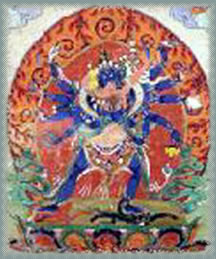
Once upon a time, eight members of each world came to the earth. They are recognized as eight space goers, four "minor god" (Tib. Ha) and four "smell-eater" (Tib. Dare Zap), eight ground walkers, four "malevolent harmers" (Tib. Nod Jan) and four cannibal demons (Tib. Sren Po) and eight underground dwellers, four "Nagas" (Tib. Lu) and four "demigods" (Tib. Lhamen). These twenty four non-human beings occupied twenty-four different territories on the earth. Their evil presence caused great suffering to everyone on earth. Therefore, according to the tantric tradition of Buddhism, the historical Buddha Shakyamuni from the state of Dharmakaya (the body of reality), manifested sambhogakaya (complete enjoyment body) in the most wrathful Chakrasamvara (Tib. Palkhorlo Dompa) and subdued all the invaders. Chakrasamvara is a deity with four faces and twelve hands. Since then, those twenty-four sites have been converted into palaces of Chakrasamvara. "Chakra" means wheal and "Samvara" means the supreme bliss. It is also translated as spontaneous great bliss. By practicing Heruka Tantra we gain the profound realization of the emptiness of all phenomena and beings. This realization is descried as the most great bliss of mind. Another Sanskrit term for Chakrasamvara is Heruka. The three syllables of Heruka mean, "He" means the nature of emptiness of dharma or phenomena, "Ru" means the nature of emptiness of beings. "K" means the union of bliss and emptiness. This means, by realizing the nature of emptiness of phenomena and beings is the great bliss of mind. The sexual union of Chakrasamvara and Vajrayogini (Tib. Dorjee Pegmo) symbolizes the ultimate wisdom and compassion to achieve the state of enlightenment. There are at least four different appearances of Chakrasamvara, known as Dechog or Demchog in Tibetan. The practices associated with Dechog are widely practiced by all the Tantric traditions of Tibetan Buddhism. Sites around the Sacred Crystal Mountain Pilgrims stop at each place to offer their prayers and wishes as they make their way around the sacred mountain.
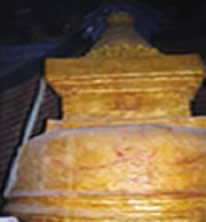
This stupa is one of the most precious objects in the Gomoche Monastery. According to historical records, the monks at the monastery left the remains of Senge Yeshi in the main shrine. Then, history continues, seven southern Indian saints appeared as birds and began to construct the stupa around his remains. The monks were instructed to leave the shrine closed for seven days, but they opened it one day early and found the incomplete stupa. It was then up to them to complete the structure. It is easy to see the difference between the part made by the "gods" and that made by the monks of the monastery. A stupa is called Chod Ten in Tibetan. "Chod" means to offer and "Ten" means an object to depend on. The two words together translate as an object for an offering which can be depended on. Buddhists take refuge in The Three Jewels, known as Konchok Sum in Tibetan, which are the body, speech and mind of Buddhas. To represent The Three Jewels, images of Buddhas are seen as the bodies, teaching books are studied as the speech, and Chod Ten are considered as representations of the Buddha's minds. Since there are countless numbers of Buddhas, there are a great number of Chod Tens; some contain the actual bodies of highly-realized Buddhist practitioners, known as Mer Thong, and others contain some precious substances, such as the burnt remains of practitioners or thousands of block- printed images of Buddhas or Chod Ten itself, known as Tsa-Tsa, and other things.
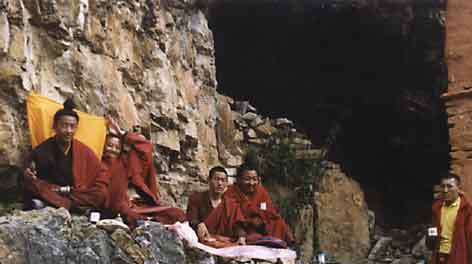
This is Dorjee cave, where Senge Yeshi retreated for nine years and gained the highest attainment of enlightenment. Most pilgrims perform heartfelt prayers and meditation here for as long as they can.
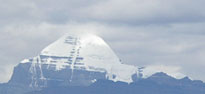
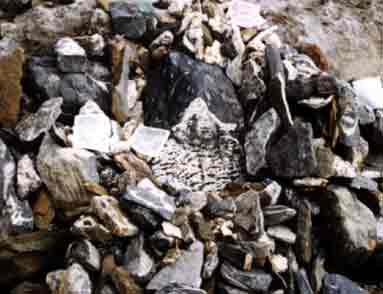
This is a natural image of the sacred Mount Kailash printed on a stone and is easily seen at the side of the path circumambulating Dolma La, the sacred Shel-Re Drugda hill. When we were there, we discovered that this region and the Mount Kailash region of western Tibet share a lot of names and a similar landscape. The most important similarity is that the sacred Mount Kailash is also known as the residence of Dechog. (Click here if you are interested in reading more about Mount Kailash.)
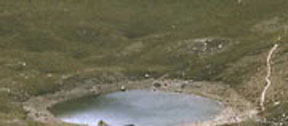
This lake is Tso Kava Le. We don't know the story of the lake, but all the pilgrims visit it and drink some of its water. The lake is something very special to see: it is as blue as the sky and, even without a water source, we were told the lake never dries up during the year.
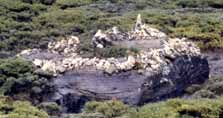
We saw lions' footprints on a rock and were told that, when Senge Yeshi was in Dolpo, he discovered there were powerful evil spirits disturbing people's lives and their spiritual practices. To stop those spirits, he had to manifest himself into three lions, which represented his body, mind and speech. Those three lions multiplied themselves into one hundred lions in order to tame the evil spirits. Their negativities were buried underneath the big rock. Now the rock is a place where pilgrims go to see the footprints of the lions and get blessed by them.
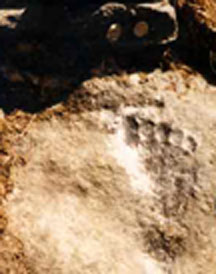
There is a very clear footprint on the rock but we didn't meet any local people who knew about it.
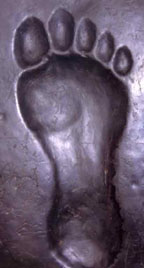
This is a footprint of Lord Jigten Sumgon, at Drikung Gonpa The Lamas at the monastery told us it was given to Lama Nagpo-Zume as a gift by Lord Jigten Sumgon himself when he was sent to Dolpo to help living beings there. Tibetan Buddhism and Shel-Re Drugda In Buddhism, masters usually define two main paths, Sutra and Tantra, through which spiritual practitioners can gain liberation from the cycle of births in this universe, and achieve the highest attainment of enlightenment for the benefit of all sentient beings. The terms Sutra & Tantra are very complex and too profound to explain in a short article such as this. However, many Buddhist masters and practitioners regard it as essential that both paths are practiced together. Simply put, Sutra refers to the original teachings of eighty-four thousand volumes which were taught by the historical Buddha Shakyamuni. Studying, contemplating and meditating on those teachings is called the "Sutra path" or gradual way of enlightenment. Tantra means "continuity" and refers to the unchanging nature of the enlightened mind. The practice of Tantra is known to be a very powerful and direct method of awakening the luminous nature of the mind. However, there has been argument inside Buddhist schools whether Buddha Shakyamuni taught the Tantric path in his lifetime or whether the tradition was founded by his awakened fellow spiritual masters. The Hinayana schools of Buddhism question the authenticity of the Tantric path by saying that there is no Sutra or original teaching by Buddha on the subject. The Mahayana schools, on the other hand, have confirmed that the Buddha Shakyamuni taught the Tantric path to those of his students who had gained high realization in their spiritual practice, but the teachings were kept secret from the general public because of the risk of misunderstanding. This is why the Tantric path is also known as the sacred path. The Tibetan Mahayana tradition accepts both Sutra and Tantra as authentic, claiming that the wisdom to understand the nature of phenomena and the method of practicing loving compassion are the root of both paths. So the Tantric practitioners study, contemplate and meditate on the Sutra teachings in conjunction with their Tantric ceremonies, which include a lot of visualization, the creation sand mandalas to bestow initiations and empowerment, oral teachings and the recitation of mantras. These practices are performed, under the close supervision of a teacher, to receive blessings and powers of the higher beings. To conclude, the methods of Tantra, though very powerful and hard to understand, are fully consistent with all the teachings of the historical Buddha. In the Tantric path, practitioners perform their observances under the guidance of living masters who have experience of the path. It is widely known in the Mahayana world that the great saints evinced extraordinary signs of their realizations and even met directly with particular deities and enlightened beings. Also, many have had day and dream visions of enlightened beings and deities. So, for Mahayana Buddhists, these deities and powers are very real, and they believe that by going on pilgrimages to holy lands, one can receive the blessings of the sacred seats of deities and places where enlightened beings used to live and practice. |
|

 The
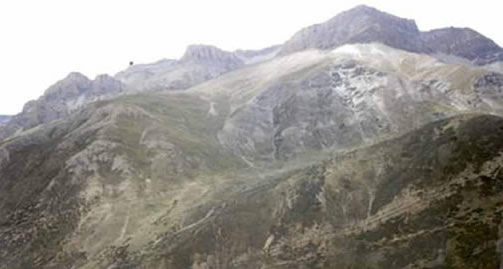
sacred mountain of Dolpo is called She-Re Drug da, which translates
as "Dolpo Crystal Mountain of The Dragon's Roar". Locally
it is known as "Shey". There is a legend which gives
the origin of the sacredness of the mountain. In general, Buddhists
categorize two types of sentient beings: those which have physical
bodies (Tib. Ugh Ka) and those, such as spirits, which don't have
physical bodies (Tib. Ugh Med Ka). All sentient beings live in
three worlds: the minor god, or celestial world (Tib. Ha Yule),
the human world (Tib. Me Yule), the Nag's world, (Tib. Klux Yule).
The
sacred mountain of Dolpo is called She-Re Drug da, which translates
as "Dolpo Crystal Mountain of The Dragon's Roar". Locally
it is known as "Shey". There is a legend which gives
the origin of the sacredness of the mountain. In general, Buddhists
categorize two types of sentient beings: those which have physical
bodies (Tib. Ugh Ka) and those, such as spirits, which don't have
physical bodies (Tib. Ugh Med Ka). All sentient beings live in
three worlds: the minor god, or celestial world (Tib. Ha Yule),
the human world (Tib. Me Yule), the Nag's world, (Tib. Klux Yule).
 In
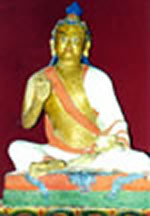
the 12th century, a Buddhist practitioner named Druptop Senge
Yeshi was sent to Dolpo by his master Kyabpa Jigten Sumgon, the
founder of the Drikung Kagyu Order. On his arrival on the hilltop
of Zhegpa Gang, Senge Yeshi flew through the middle of a huge
rock on his way up the sacred mountain of Shel-Re Drugda. There
he saw Chakrasamvara (the tantric deity, Dechog) at the Crystal
Mountain, and through the power of his meditative realization,
he heard the sound of a dragon's roar. Having directly perceived
the holiness of the mountain, Senge Yeshi christened it "Shel-Re
Drugda" and, riding on a lion, he blessed the sacred land.
The hole in the rock through which Senge Yeshi flew can still
be seen and his dharma activities are recorded in historical books
and oral stories still told by the people of the Dolpo region.
In
the 12th century, a Buddhist practitioner named Druptop Senge
Yeshi was sent to Dolpo by his master Kyabpa Jigten Sumgon, the
founder of the Drikung Kagyu Order. On his arrival on the hilltop
of Zhegpa Gang, Senge Yeshi flew through the middle of a huge
rock on his way up the sacred mountain of Shel-Re Drugda. There
he saw Chakrasamvara (the tantric deity, Dechog) at the Crystal
Mountain, and through the power of his meditative realization,
he heard the sound of a dragon's roar. Having directly perceived
the holiness of the mountain, Senge Yeshi christened it "Shel-Re
Drugda" and, riding on a lion, he blessed the sacred land.
The hole in the rock through which Senge Yeshi flew can still
be seen and his dharma activities are recorded in historical books
and oral stories still told by the people of the Dolpo region.
| All contents of this website © 2005 Kailashzone Charitable Foundation |
