









 |
The Monastic and Cultural Events
There
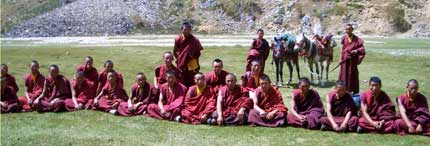
are over ninety monks in Limi. Job of the monks is to perform annual
religious ritual for benefit of all living beings and to secure
health and prosperity of the people. Each date has a special significant.
The monks practice different rite and ritual performances.
22nd of 9th Tibetan lunar Month This is called Lha-Bab-Duchen in Tibetan and is the fourth most important date in Buddhism. On this day, Gautama Buddha was conceived, became a Buddha, entered Nirvana and descended from among the god's realm. The monks in Limi perform a day-long ritual ceremony to celebrate the occasion and the villagers come to the monasteries to make their offerings and prayers. 9th of 10th Tibetan lunar Month
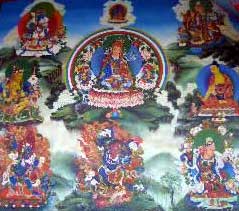
On this date, the monks gather to practice Guru Dagpo Tor-Gyag, which lasts between 7 and 9 days. "Guru" in Tibetan refers to the great Indian master, Pedmasambhava, who came to Tibet in the 8th century; "Dagpo" means wrathful; "Tor-Gyag" means to clean something up. The whole phrase can therefore be translated as "cleaning up negativities through the ritual power of the wrathful Guru". This ritual is sponsored by the villagers and is performed to ensure their safety. It is believed that Guru Rinpoche (Pedmasambhava) has emanated through eight different embodiments in order to fulfil the spiritual requirements of all sentient beings. Guru Dagpo, the wrathful Guru, has special power to subdue untamed living beings who cause suffering to others. During the ritual, a symbolic object (Tib. Torma) is either thrown away or burned, thus dispelling all unwanted things, including sickness, famine, conflicts, war, and so on. On completion of Guru Dagpo Tor-Gyag, all the villagers come to the monastery to celebrate the fact that they will live happily from then on. The monks perform Lama Dances, (Tib. Cham) and the lay people present traditional songs and dances, especially the ancient Tibetan dances, Gar and Shon.
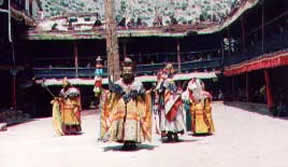
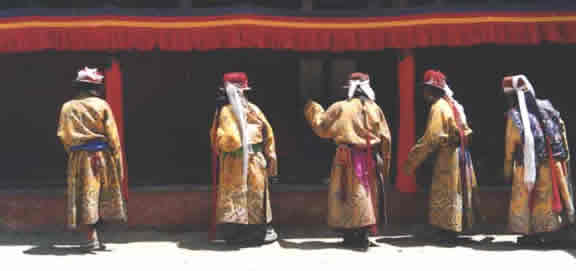
Through the presentation of the Lama Dances, the audience is introduced to beings which they cannot see from other realms. The dancers wear masks which represent the appearance of the other beings. Some masks are peaceful and smiling, whereas others are angry and frightening. This is so that members of the audience will not be frightened or mistaken about the other beings they will encounter after death. There are a great number of symbolic objects, which are worn, carried or played by the dancers. Generally, Lama dances are only performed by monks, although monks are not permitted to dance as part of their ordination vows. .
Shon and Gar are unique, ancient Tibetan slow motion dances which are only performed in the Ngari region of Tibet. (This includes Limi, although the area is now officially part of Nepal.) Shon is danced only by women and Gar only by men. In these particular dances, performers slowly move anti-clockwise. This proves that the dances were performed in Tibet earlier than the 7th century. We know this because Bon (the indigenous Tibetan religion, still practiced today) favours anti-clockwise movement. In the 7th century, Buddhism was brought to Tibet and became the national religion. Buddhists favour clockwise movement and, as the whole Tibetan culture changed, all other dances were then performed the Buddhist way. 25th of 10th Tibetan lunar Month This date is the pari-nirvana (passed away) anniversary of the founder of the Gelug Tradition of Tibetan Buddhism, Je Tsongka Pa. Monks gather to perform a memorial ritual ceremony which lasts the whole day. At night, the monasteries and the villagers light hundreds of butter lamps and the special prayer of Tsongka pa (Meg-Tsuma) is recited in every household. 1st of 11th Tibetan lunar Month The day is celebrated as the official New Year in Limi and many other parts of Tibet. Tibetan people celebrate New Year at three different times: many farmers have their New Year on 1st of 11th Tibetan month; many nomads celebrate on 1st of 12th Tibetan month; while the people in the centre of the country celebrate the official New Year on 1st of 1st Tibetan month. The monks gather to perform Lama Chod Pa (Guru Yoga) for the whole day. "Lama" in Tibetan has two meanings: a Buddhist teacher is called Lama, which is the Tibetan term equivalent to "Guru" in Sanskrit; and a reincarnation is also called Lama. Chod Pa is a ritual ceremony with prayers and offerings to the lineage masters. It can also be interpreted as requesting prayers to bestow blessings. Different traditions of Buddhist lineages have their own Guru Yoga. From 25th of 11th Tibetan lunar Month For a month and half, the monks go around every household to read all their Buddhist scriptures. The villagers believe this reading of the Dharma books can earn great merit for this life and the next lives until they achieve the state of enlightenment. It also brings positive energy to the household. Most big households have twelve volumes of Bum and three volumes of Nyi-Tri, Gyed-Tongpa and Zong-Du. It takes one or two days for a monk to read a volume of the books. ("Bum" means one hundred thousand). The twelve volumes of Bum contain one hundred thousands verses of the original teachings of Buddha on the profound philosophy on emptiness, or the middle way system. ("Nyi-Tri" means twenty thousands). The three volumes of Nyi-Tri books are summaries of the twelve volumes of Bum in twenty thousands verses . ("Gyad" means eight and "Tong" means a thousands). Gyad Tongpa is eight thousands verses of short version of Bum. Zong-Du ("Zong" means essence and "Du" means collection) is a collection of all the quintessential teachings and mantras of all the Buddhas and Bodhisattvas. From 22nd of 12th Tibetan lunar Month
Yeshi Pa Lha are those who have achieved liberation from Samsara. It is believed that they are free from all defilements, including the three root causes of Samasara - ignorance, attachment and anger - and they have made a commitment to protect and support those practitioners who request their help in their religious practices and worldly activities. Their image is drawn with a third eye at the centre of the forehead. The three eyes stand the three times. If he or she can't help living beings, they at least cause no harm. "Jig Ten Pe Lha" are those who are still in Samsara and are same as any other living being. When they get what they want, they give protection and support to accomplish whatever you wish; if they don't like anyone for any reason, they cause suffering. These deities have no ability to safeguard next lives or to be guides on the path to liberations. Therefore, they are known as world deities, Jegten Pe Lha in Tibetan. There are eight different Gonpos, who share an identity but have different appearances and abilities. He has so many embodiments because it is necessary in order to fulfil the spiritual requirements of different living beings with different dispositions. "Gonpo Jarog Dongchen" means "Gonpo with the face of a crow". "Gonpo Jarog Dongchen Tor-Gyag" can be translated as, "cleaning up negativities through the ritual ceremony of Gonpo Jarog Dongchen". This is funded by the monasteries and is aimed to safeguard them. It is also regarded as an antidote to spiritual obstacles to engaging in religious activities. 7th to 18th of 1st Tibetan lunar Month The recitation of Ma-Ne with the great intension wish to free all living beings from suffering to be the most powerful mantra and the most popular practice among all stages of Tibetan Buddhists practitioners. From 10th of 1st Tibetan lunar Month For eight days, the villagers practice Nyung-Nas. This is one of the religious practices for lay people. At the gathering, there will be a monk to act as master, Lama, and lead the group through the ceremony. The practice contains a series of activities. Two days make one set. The first day is Nyi-Nas, when those taking part eat breakfast and lunch. Next is Nyung-Nas, when no-one should eat or drink at all, though the elderly and very young may have a light lunch and a cup of tea. According to the rule of the three villages of Limi, every big household should have at least one person attending Nyung-Nas. The small households can leave after 4 days if they want. The single-woman households have to send one person for two days. Those who wish to stay longer are always welcome, and any household may send more than one person. All practitioners need to bring their beds to the village hall and someone has to deliver their food. - From 1st of 2nd Tibetan lunar Month
From 10th of 4th Tibetan lunar Month For eight days, the monks and lay people practice Nyi-Nas and Nyung Nas. 25th of 4th Tibetan lunar Month The day is the pari-nirvana anniversary of Lord Jigten Sumgon, the founder of the Drikung Kagyu Order. Weltse Monastery and Zang Monastery display three floor-height Thangkas (Gos Kus in Tibetan) outside their monasteries. The Gos Ku at Weltse Rinchen Ling Monastery is Lord Jigten Sumgon, the founder of the Drikung Kagyu Order, and is as high as a three-storey building. Above Jigten Sumgon, there is an image of Dorjee Cheng (Vajradhara). At Jigten Sumgon's knee-height, there are two images representing the two lineage holders of the Drikung Kagyu Order, His Holiness Drikung Chetsang and His Holiness Drikung Chungtsang. Underneath Jigten Sumgon, there are three images - Dechog, Achie, and Gonpo. These three are Dharma protectors and deity in the Drikung Kagyu Order. This Gos Ku has been there for hundreds of years, and is one of only a few its kind in the world. In 1998 with the help of the current His Holiness the Drikung Chungtsang, Zang Monastery bought a new Gos-Ku from Lhasa, which is similar to the old one in Weltse Monastery. Daily Ritual At The Monasteries Every day, the monks perform Kang-dos and Kang-sol in their monasteries. "Kang" means to satisfy or to fulfil and "dos" means to get rid of obstacles to engaging in activities. Kang-sol is a similar ritual, with "Kang" as above and "sol" meaning a request for a favour to accomplish worldly and spiritual activities. Kang-dos and Kang-sol are both performed in front of Dharma Protectors, who are known as Dharma Protectors (Sung Ma, Lha Sung in Tibetan). The main Dharma Protectors of the Drikung Kagyu Order are Achie and Gonpo. | |
|
 The
Lama Dance is an unique Tibetan tradition and one of the methods
used to teach Buddhism to people. According to Buddhism, there are
six realms (states of living beings): god, demigod, human, animal,
hungry ghosts and hell. These states are achieved by liberation
through circling births after deaths known as Samsara. Ignorance,
attachment and anger are defined as the root causes of Samsara and
are named as the Three Poisons of Trouble (Nyon Mong Dugsum, in
Tibetan). Those who are able to free themselves from Samsara are
defined as liberated beings and are known as Buddhas and Bodhisattvas.
Only those referred to as emanations are believed to have gained
liberation from Samsara and they use their Great Compassion to show
the path of liberation to all sentient beings. They take re-births
as if the cycle of birth and death is under their control.
The
Lama Dance is an unique Tibetan tradition and one of the methods
used to teach Buddhism to people. According to Buddhism, there are
six realms (states of living beings): god, demigod, human, animal,
hungry ghosts and hell. These states are achieved by liberation
through circling births after deaths known as Samsara. Ignorance,
attachment and anger are defined as the root causes of Samsara and
are named as the Three Poisons of Trouble (Nyon Mong Dugsum, in
Tibetan). Those who are able to free themselves from Samsara are
defined as liberated beings and are known as Buddhas and Bodhisattvas.
Only those referred to as emanations are believed to have gained
liberation from Samsara and they use their Great Compassion to show
the path of liberation to all sentient beings. They take re-births
as if the cycle of birth and death is under their control. 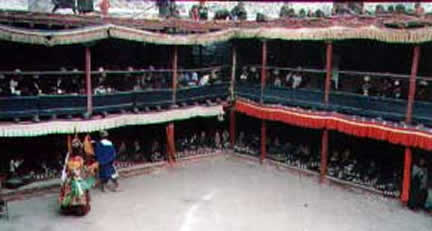
 For
a week, the monks perform Gonpo Jarog Dongchen Tor-Gyag. "Gonpo"
is believed to be an emanation of Dechog (Chakrasamvara) and is
a Yeshi Pa Lha. "Yeshi Pa" means one who has gained the
ultimate wisdom to see the realms of both Buddha and Samasara; "Lha"
is a deity or god. There are several types of deity (two of which
are Yeshi Pe Lha and Jigten Pe Lha) which are "Sungma",
or Dharma Protectors. ("Sung" means protect; "Tor-Gyag"
means to clean up.)
For
a week, the monks perform Gonpo Jarog Dongchen Tor-Gyag. "Gonpo"
is believed to be an emanation of Dechog (Chakrasamvara) and is
a Yeshi Pa Lha. "Yeshi Pa" means one who has gained the
ultimate wisdom to see the realms of both Buddha and Samasara; "Lha"
is a deity or god. There are several types of deity (two of which
are Yeshi Pe Lha and Jigten Pe Lha) which are "Sungma",
or Dharma Protectors. ("Sung" means protect; "Tor-Gyag"
means to clean up.) For
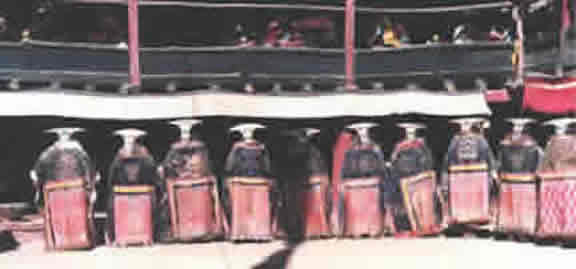
24 hours, the monks meet together to recite Ma-Ne (the six-syllable
mantra of Chen-Rizeng or Avalokitesvara. Avalokitesvara is known
as the Buddha of compassion. The six syllables are: Om, Ma, Ne,
Pad, Me and Hung. Each letter represents the six realms of Samsara
for living beings - god, demigod, human, animals, hungry ghost and
hell.
For
24 hours, the monks meet together to recite Ma-Ne (the six-syllable
mantra of Chen-Rizeng or Avalokitesvara. Avalokitesvara is known
as the Buddha of compassion. The six syllables are: Om, Ma, Ne,
Pad, Me and Hung. Each letter represents the six realms of Samsara
for living beings - god, demigod, human, animals, hungry ghost and
hell. 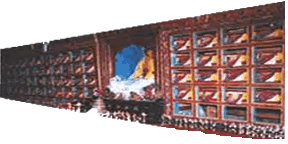 For
15 to 20 days, the monks read the 100 volumes of Kagyur. These books
contain all the teachings of Gautama Buddha. A monk can read a volume
a day. Unfortunately, the monks from Limi have a very limited knowledge
of Buddhist philosophy; in fact, almost none of the monks has received
any training in the philosophical teachings. Therefore, the monks
understand very little of what they are reading and it is unusual
to see lay people listening to what the monks are reading.
For
15 to 20 days, the monks read the 100 volumes of Kagyur. These books
contain all the teachings of Gautama Buddha. A monk can read a volume
a day. Unfortunately, the monks from Limi have a very limited knowledge
of Buddhist philosophy; in fact, almost none of the monks has received
any training in the philosophical teachings. Therefore, the monks
understand very little of what they are reading and it is unusual
to see lay people listening to what the monks are reading. 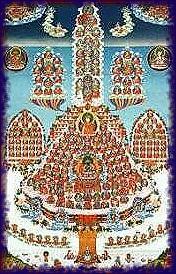 The
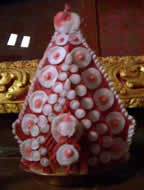
monks gather to perform Lama Chodpa Tsok (Guru Yoga Food Offering).
Tsok offering is a ritual to invite all the lineage teachers and
all other related members, such as deities to enjoy the food. Traditionally,
Tsok are made out of Tsampa (roast barley flour), with butter, cheese
and sweets, and are shaped like a round mountain. In the ritual,
the enlightened beings and the lineage teachers are asked to bless
the Tsok, which are then distributed to people as blessed food.
It is believed that performing the Tsok offering purifies unwholesome
deeds and accumulates great merit to create peace in the surrounding
environment.
The
monks gather to perform Lama Chodpa Tsok (Guru Yoga Food Offering).
Tsok offering is a ritual to invite all the lineage teachers and
all other related members, such as deities to enjoy the food. Traditionally,
Tsok are made out of Tsampa (roast barley flour), with butter, cheese
and sweets, and are shaped like a round mountain. In the ritual,
the enlightened beings and the lineage teachers are asked to bless
the Tsok, which are then distributed to people as blessed food.
It is believed that performing the Tsok offering purifies unwholesome
deeds and accumulates great merit to create peace in the surrounding
environment.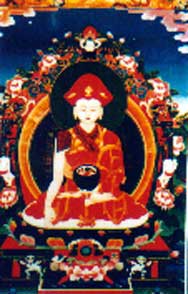 The
Tibetan word "Thangka" is commonly used to refer to the
art of religious painting. Pictures, which are painted on a wide
range of coloured fabrics or paper, are produced from gold, silver,
precious stones or other materials. Painting on a wall is called
Deb Re in Tibetan. There are other methods to create a Thangka,
which include weaving, sewing or patchwork. "Gos" means
a fabric and "Ku" means image. A Gos Ku can be any depiction
of Buddhas and Bodhisattvas.
The
Tibetan word "Thangka" is commonly used to refer to the
art of religious painting. Pictures, which are painted on a wide
range of coloured fabrics or paper, are produced from gold, silver,
precious stones or other materials. Painting on a wall is called
Deb Re in Tibetan. There are other methods to create a Thangka,
which include weaving, sewing or patchwork. "Gos" means
a fabric and "Ku" means image. A Gos Ku can be any depiction
of Buddhas and Bodhisattvas. 










| All contents of this website © 2005 Kailashzone Charitable Foundation |
