










 |
Til Kunzom Dhongag Choe Ling Monastery
The monastery was built on the spot where a Buddhist practitioner came on a solitary retreat in the 12th century. His name was Lama Kunzom. The cave where he meditated is still below the monastery. The hill where the monastery is situated is like a white snake heading up and a black snake heading down. The monastery is located on the ear of the black snake, which symbolises that it is famous for its contents. (If the monastery had been situated on the mouth of the snake, it would have received endless offerings). Lama Kunzom later offered the monastery to Druptop Senge Yeshi, who was a disciple of Kyabpa Jigten Sumgon, the founder of the Drikung Kagyu Order. "Druptop" translates as Mahasidda in Sanskrit and is used as a title for Buddhist practitioners. "Drup" literally means practice and "Top" means achieved, in Tibetan. Druptop Senge Yeshi was on a meditation retreat in the hermitage of Lotsa Wa Rinchen Zangpo at Chaye Namkha Zhong, not far from Tel village. There is a story about Lama Kunzom and Senge Yeshi. Lama Kunzom had an audience with Senge Yeshi. Afterwards, Senge Yeshi became very ill and thought he wasn't going to live any longer, despite the prayers of all his fellow-meditators. So his friend, Rinchen Senge, went to inform Lama Kunzom of the situation. Lama Kunzom wrote a letter requesting Senge Yeshi not enter pari-nirvana and sent it to him with a scarf, Katag in Tibetan. When Senge Yeshi read the message, he said to his followers, "Even Lama Kunzom has asked me to stay. I will try to meditate and all of you must pray and perform a long-life ritual." Senge Yeshi eventually recovered from his illness and lived on as the spiritual master of the religious practitioners in the region. After Druptop Senge Yeshi's pari-nirvana, he disappeared. Because of the people of Limi's unshakeable true faith in Druptop Senge Yeshi and Senge Yeshi's great compassionate wish to be a guide to the path of the liberation, he has emanated in continuous reincarnations to the present day. The reincarnations of Senge Yeshi have served as the head of the spiritual world of Limi for centuries and they have earned the title, Limi Tulku (the reincarnation of Limi). The current reincarnation is known as Senge Tenzin and was born in the western part of Tibet in 1981.
The importance of the Thupa images cannot be expressed in words. Still today, when a epidemic spreads through Limi, the image takes the sickness and becomes sick himself. How do we know this? Because black spots appear on the face of the image and when the sickness goes away, the image recovers its normal appearance. Traditionally, such cases are kept secret by the monks and they cover the image in a clean cloth. A remarkable footprint of Drikung Che-Nga Langpa and his yak are one of the monastery's precious objects. Originally, they were at Aru La pass, where a visitor has a clear view of Tel Kunzom Dhongan Choeling. Drikung Che-nga Langpa prayed that they would always have a Druptop (mahasidda). Right up to the present day, Til monastery has always had a Druptop. There are over 50 small images, which represent enlightened Buddhas, Bodhisattvas, Dharma Protectors and others, which have been made from a wide variety of materials. The monastery also has some old Thangka paintings and some beautiful wall paintings, especially in the cave where Kunzom Lama lived.
In 1997 a new hall was inaugurated by the current His Holiness the Drikung Chetsang Rinpoche. The main contents of the new temple are: 36-inch-high images of Thonpa (Buddha Shakyamuni), Guru Nangsed Zelnon, (one of eight Guru Pedmasambhava), Kyabpa Jigten Sumgon, (the founder of the Drikung Kagyu Order). Together these three symbolize the three embodiments known as Kayas in Sanskrit and Ku Sum in Tibetan. The embodiments are: Choe Ku (Dharmakaya) who is Buddha, the enlightened one; Long Ku (Sambokaya) is Guru Nangsed Zelnon, who is the embodiment of knowledge; and Tulku (Nirmakaya) is Jigten Sumgon, the reincarnated one. These three are seen as one entity but have different appearances to benefit living beings. The idea can be used with other beings who are Enlightened, who are an embodiment of knowledge and wisdom and who are a reincarnation, as long as it is genuine. We can place a value on these images because they were made recently in Kathmandu. The base of the images is copper, burnished with gold. The gold alone cost 308,000 Nepalese rupees (US$ 4278) and there are also 130 settings of precious jewellery.
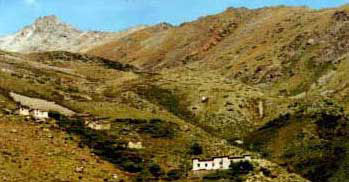
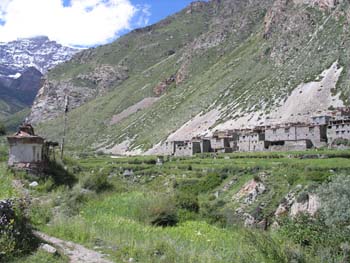
Kunzom Dhongag Choeling is in Til the nearest village to the northwest of Limi. There are 40 households and over 200 people. The villagers of Til are known as Tilwa. | |
|
 The
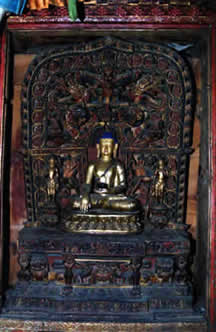
main contents of Kunzom Dhongag Choeling are: a 25-inch-high image
of Thupa ( Buddha Shakyamuni) which is over a thousand years old.
The villagers refer to the image as Sung-Jon-Tashi-Od-Bar (the great
shunning speaker), as it is believed the image has spoken 13 times
at different periods of history. There is a 12-inch Gyalwa Jampa
(Buddha Maitreya) on the left side of the Thupa, and a 12-inch Chen-Ri-Zig
(Avalokiteshvra) on the right. All three images are made from Ser-Sang.
"Sang" means copper, and is one of the materials popularly
used in the making of images; "Ser" means gold, and can
be used either for the whole image or only for the face. The wooden
altar for the three images is one and a half meters high and is
covered in over 37 images, Krie-Drug (six thrones) and Gyan-Drug
(eight ornaments).
The
main contents of Kunzom Dhongag Choeling are: a 25-inch-high image
of Thupa ( Buddha Shakyamuni) which is over a thousand years old.
The villagers refer to the image as Sung-Jon-Tashi-Od-Bar (the great
shunning speaker), as it is believed the image has spoken 13 times
at different periods of history. There is a 12-inch Gyalwa Jampa
(Buddha Maitreya) on the left side of the Thupa, and a 12-inch Chen-Ri-Zig
(Avalokiteshvra) on the right. All three images are made from Ser-Sang.
"Sang" means copper, and is one of the materials popularly
used in the making of images; "Ser" means gold, and can
be used either for the whole image or only for the face. The wooden
altar for the three images is one and a half meters high and is
covered in over 37 images, Krie-Drug (six thrones) and Gyan-Drug
(eight ornaments). 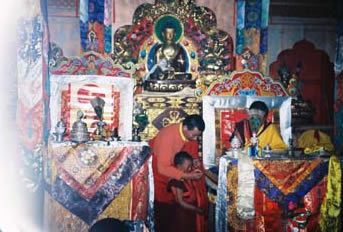










| All contents of this website © 2005 Kailashzone Charitable Foundation |
