










 |
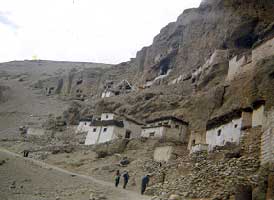
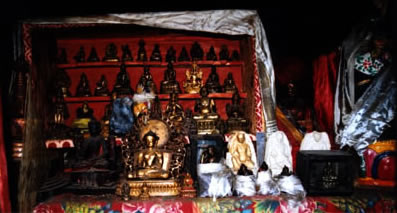
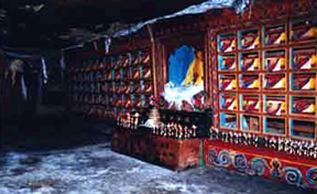
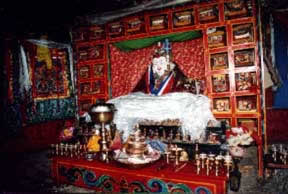
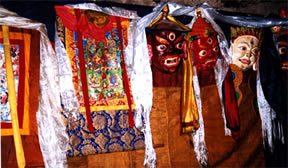
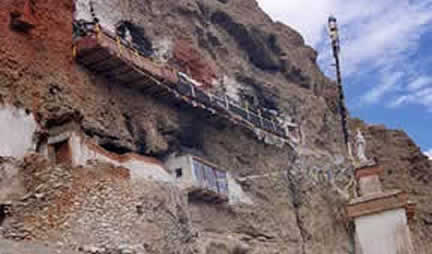 Gongphur Monastery is situated on the side of Tegla Kar Mountain, 1 kilometer from Purang County. The monastery is open to pilgrims and visitors seven days week. It has six cave-temples: Du-Kang (the main hall), where the sacred objects are kept on the altar and the monks get together to practice Dharma activities; Kagyur Lhakang (the Sutra Temple), where the 108 books of Buddha Shakyamuni's teachings are kept; Gon Khang (Dharma Protectors' Room), where masks and paintings of Dharma Protectors are displayed; Palde Lhakang (a small shrine); and Kayab. The last two are retreat caves where both monks and lay people go for secluded religious practices.
An oral history of Gongphur Monastery says that once upon a time, Purang was recognized as the Kingdom of Jangchog Ngadhen, whose king was Gyalpo Norsang. Still today, elders can prove this with names of local places dating back to the time of King Norsang. Gongphur Monastery was the residence of the celestial wife of King Norsang, Yedrog Lhamo. "Gongphur" means "flew in space". The oral story tells how the celestial wife, Yedrog Lhamo, flew to the realm of the gods through the rock of the cave when she was put in danger by the two thousand and five hundred jealous wives of King Norsang. As a result, the cave is sacred and was turned into a place of worship. There are also a number of other caves below Gongphur which were said to be the residences of the king's two thousand and five hundred wives. The fort of King Norsang, Gyalte Khar (the fort of the king), was discovered opposite Gongphur. Today, a Chinese military camp is based where the fort used to be. There are many more places in Purang connected with the legend of King Norsang. In the 1960s, the Cultural Revolution was launched in Tibet. No monasteries escaped its devastation. In the Purang Region and Gongphur many holy articles were lost, caves were damaged, and balconies and stairs were destroyed. Despite this, some people managed to enter the main hall by making a hole in the side of the cave. Fortunately, during the night, concerned monks of the Drikung Kagyu Order and fellow villagers secretly carried away many holy images from under the noses of the Chinese guards and, with the agreement of the villagers, the images were deposited in the Tel Kunzom Ling Monastery in Nepal, in 1967. After nineteen years, the government of China gave the Tibetan people what it called "freedom of religion". Seeing the light of spirituality rising in the east, people from the two villages of Geshing and Dosa in Purang went to Limi in Nepal, to bring back the precious images and the other objects. For three years, the villagers kept the sacred objects in a temporary room at Geshing village. In 1985, Gongphur was re-installed, mainly thanks to the hard labor of the sincere villagers of Geshing and Dosa (two villages in Purang which practice the Drikung Kagyu Order of Tibetan Buddhism). Now, Gongphur is like a pillar sustaining their religion for the inhabitants of Purang and visitors from outside the region. The contents of Gongphur Monastery are as follows:
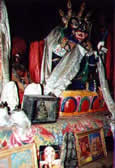
Achie is one of the Dharma Protectors of the Drikung Kagyu Order. "Achie" translates as grandmother. "Choe" means Dharma in Sanskrit and Buddhism in English. "Kyi" means of, "Dolma" means escort and translates as Tara in Sanskrit. Achie Choe Kyi Dolma was a female born in 1027 in the village of Kye Drag, in Tibet. When she was alive, she showed her compassion toward all sentient beings without making any distinction between them. Therefore, she was named Choe. The principle of Buddhism is to benefit others. She was believed to be an emanation of Tara and was referred to as Dolma. Tara was an Indian woman, who is believed to have gained the state of liberation thorough her spiritual practices and has emanated to show the path of the liberation. She was called "Achie", because she was the grandmother of Kyabpa Jigten Sumgon, the founder of the Drikung Kagyu Order. Dharma Protectors or deities are known by two names "Lha" or "Sungma" in Tibetan. In general, there are two types of deity or Dharma Protector, known as Yeshi Pe Lha and Jigten Pas Lha. Those deities who have attained liberation from Samsara are known as Yeshi Pe Lha. It is believed that they are free from the three root causes of Samsara - ignorance, attachment and anger. In other words, on their liberation, they made a commitment to protect Buddhism and religious practitioners who request their support and protection in religious practices and worldly activities. Deities or Dharma Protectors who are recognized as Yeshi Pe Lha are depicted with a third eye in the centre of their forehead and their specialty is to help sentient beings and cause no harm to anyone. "Jig Ten Pe Lha" are those deities who are still in Samsara and are same as any other living beings. Therefore, when they get what they want, they protect and support followers in accomplishing whatever they want. If they don't like someone for any reason, they cause suffering. Those deities have no ability to safeguard future lives or to show the path to liberation. They are therefore known as worldly deities, Jegten Pe Lha in Tibetan.
It is believed that performing in Achie Kang Sol, she enjoys the ritual words of praise and offerings and she gives her protection and guidance for whatever purpose the ritual is performed. Therefore, there are a regular visitors at Gongphur Monastery requesting the monks to perform Kang Sol ritual. The monks at Gongphur perform a wide range of ritual ceremonies on different dates and occasions and at the request of visitors.
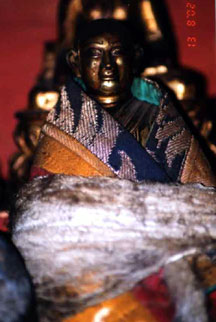
An statue of Jigten Sumgon, is one of the most precious objects in the monastery. The monks refer to the statue as Kyabpa Chim Jesma. "Kyabpa" means savior, referring to Jigten Sumgon, the founder of the Drikung Kagyu Order, and "Chim Jesma" means tooth printed one. There is a story to relate the statue. When Jigten Sumgon was alive, a thousand statues of Jigten Sumgon were made. Then, he was requested to bless them. Jigten Sumgon bit one statue on the head. Maliciously, the same teeth printed appeared on all the statues. Later, the statues were distributed to the monasteries of Drikung Kagyu Order. It is believed the statue in Gonghur spoke in the past. There are many enlightened images of Buddhas and Bodhisattvas and some beautiful paintings on the walls. Additionally, there is a hand print of Kyabgon Tenzin Shawe Lodro (1889-1943), who was the predecessor of the current His Holiness the Drikung Chetsang Rinpoche.
Gongphur Monastery is the bedrock of the people's faith and a spark of spiritual light in Purang. Having the monastery accumulates immeasurable merits and benefits to all sentient beings and especially the regional villagers, who come to Gongphur when they are celebrating or suffering any misfortune in their lives.
Kagyur Temple is the second largest cave at Gongphur Monastery. In the centre, there is an image of Buddha Shakyamuni, which is made of Med-Dam (a mixture of clay, herbal grass and other materials). The word "Ka" means original and "Gyur" means translate. Kagyur translates as the original teachings of Buddha Shakyamuni, the founder of Buddhism. In the Indian Sanskrit language, the books are known as Sutra. There are 100 volumes and it is believed these books contain a complete teachings of Buddha Shakya. It takes one day for a monk to read one volume and the monks at Gongphur put all their effort into reading all the books once a year.
Gon Khang means room of "guardians" and is a special temple, where only the Dharma Protectors' masks, paintings and images are kept on the altar. Most Tibetan monasteries have a Gon Khang and none of them allow public access into this temple, except for the people and the households who worship the Dharma Protectors. The main reason not have public access to a Gon Khang is because Dharma Protectors are not necessarily to be treated as Buddhas and they can effectively cause both harm and support.
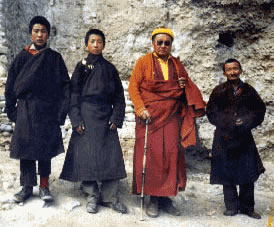
This was true at Gongphur when the monastery reopened in 1985. By then, there was only one monk still living who had been at Gongphur before the Cultural Revolution and who was able to perform ritual activities in the monastery and teach novices and perform religious ceremonies at the request of the villagers. Leles Puntsok, working alone, has not been able to do much because Gongphur's five monks are too busy taking care of the monastery and performing vital ritual services at the villagers' request. In times past, there was a tradition of educating young monks in larger monasteries in profound and complex studies in Buddhism. Branch monasteries and small monasteries like those in Limi performed spiritual activities and ritual service for the needs of the villagers. But today the old Tibetan traditions are no longer practiced and only a few old monks are left to try to train young monks in ritual practices and Buddhist philosophy. However, most of them are unable to accomplish their goal because of limited financial resources and cannot pay for food, clothing or shelter for novices or for enough qualified teachers. Gongphur now has a total of thirteen monks; however the government only permits five monks to live in the monastery. The rest of the monks have therefore joined government schools in Tibet and four adult monks escaped to India to pursue higher education in major monasteries, such as the Drikung Kagyu Institute. | |
|
|||||||||||||||||||||||||||||||||||||||
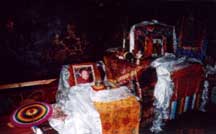 In
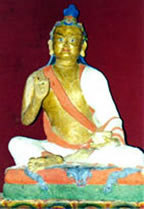
the 12th century, Gongphur Monastery was offered to Druptop Senge
Yeshi by Tagtse Krimbar, the king of the Purang Kingdom, as payment
for his Buddhist teachings. Drupthob Senge Yeshi was a close disciple
of Kyabpa Jigten Sumgon, the founder of the Drikung Kagyu Order.
Up to the present day, a continuous reincarnation of Druptop Senge
Yeshi (Limi Tulku) has served as the head of Gongphur Monastery.
In 1994, the current Reincarnation of Senge Yeshi, Senge Tenzin
Rinpoche, was recognized and enthroned by His Holiness the Drikung
Chetsang at Janchub Ling Monastery in India.
In
the 12th century, Gongphur Monastery was offered to Druptop Senge
Yeshi by Tagtse Krimbar, the king of the Purang Kingdom, as payment
for his Buddhist teachings. Drupthob Senge Yeshi was a close disciple
of Kyabpa Jigten Sumgon, the founder of the Drikung Kagyu Order.
Up to the present day, a continuous reincarnation of Druptop Senge
Yeshi (Limi Tulku) has served as the head of Gongphur Monastery.
In 1994, the current Reincarnation of Senge Yeshi, Senge Tenzin
Rinpoche, was recognized and enthroned by His Holiness the Drikung
Chetsang at Janchub Ling Monastery in India.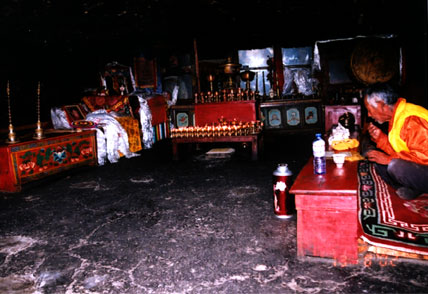
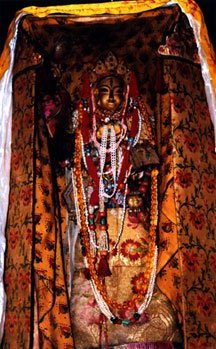 The
Gathering Hall houses a great number of sacred old objects.
Its main contents are: A standing statue of Achie Chokyi
Dolma. We have yet to find out in what period of history
the Achie came to Gongphur Monastery. It is made of silver and plated
in gold. It is believed that a finger of Jigten Sumgon is one of
the objects inside it. It is a Tibetan Buddhist tradition that there
is a wide range of material requirements to fill newly-made images
and Stupas. The jewels ornamenting the Achie image were offered
by the villagers of Purang and visiting pilgrims. Many of them were
owned by people who had already passed away.
The
Gathering Hall houses a great number of sacred old objects.
Its main contents are: A standing statue of Achie Chokyi
Dolma. We have yet to find out in what period of history
the Achie came to Gongphur Monastery. It is made of silver and plated
in gold. It is believed that a finger of Jigten Sumgon is one of
the objects inside it. It is a Tibetan Buddhist tradition that there
is a wide range of material requirements to fill newly-made images
and Stupas. The jewels ornamenting the Achie image were offered
by the villagers of Purang and visiting pilgrims. Many of them were
owned by people who had already passed away. 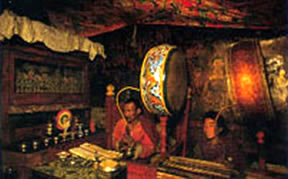 At
Gongphur Monastery, the monks perform a daily ritual known as Achie
Kang Sol. "Kang" means to satisfy and "Sol"
means to pray. Before the monks practice the actual Kang Sol ritual,
they prepare offerings, which include Metog (flowers), Dugpos (incense),
Mermed (butter lamps), Shal-Zas (rolls made from Tsampa flour and
shaped like a stupa), Shebsal (cups of water, alcohol and tea),
music and many other things. In Achi Kang Sol, it is especially
important to offer the right foreleg of a sheep. There is a story
relating to this: Achie decided to give a wedding party but she
had no food for her guests. So the villagers offered her the right
foreleg of a sheep. She said, "this is very auspicious and
it signifies that I am going to give birth to four children, and
their descendants will carry out great religious activities".
At
Gongphur Monastery, the monks perform a daily ritual known as Achie
Kang Sol. "Kang" means to satisfy and "Sol"
means to pray. Before the monks practice the actual Kang Sol ritual,
they prepare offerings, which include Metog (flowers), Dugpos (incense),
Mermed (butter lamps), Shal-Zas (rolls made from Tsampa flour and
shaped like a stupa), Shebsal (cups of water, alcohol and tea),
music and many other things. In Achi Kang Sol, it is especially
important to offer the right foreleg of a sheep. There is a story
relating to this: Achie decided to give a wedding party but she
had no food for her guests. So the villagers offered her the right
foreleg of a sheep. She said, "this is very auspicious and
it signifies that I am going to give birth to four children, and
their descendants will carry out great religious activities".




| All contents of this website © 2005 Kailashzone Charitable Foundation |
