










 |
Weltse Rinchen Ling monastery
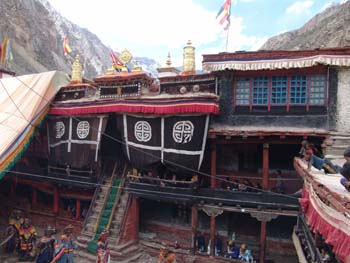
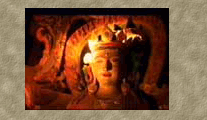
The monastery was founded in the early 10th century by "Lotsawa" Rinchen Zangpo, one of the great Tibetan translators, who had studied Buddhism and other subjects in India. On his return home, he became the foremost Buddhist practitioner in Tibet and was famous and respected during that period of Tibetan History. He established 108 monasteries and institutes including Weltse Rinchen Ling Monastery and was given his first name, "Rinchen", as a reminder of and a blessing to the future flourishing of Buddhism in the monasteries. The Monastery had previously followed the Khadam tradition of Tibetan Buddhism. Then, Rinchen Ling came under the Sakyapa Order and a tax was levied on local people to support the monks and the monastery. However, in the 15th century, the neighboring kingdom of Zumling had five brothers, who ruled over the Purang Kingdom. A sectarian clergyman of the Sakyapa Order at Weltse Monastery killed a monk of the Drikung Kagyu Order. The murderer disappeared. The king and the administrators of Zumling Kingdom decided to give Weltse Rinchen Ling Monastery and all its possessions to the Drikung Kagyu Order in compensation for the life of the murdered monk. Since then, for the last 600 years, Rinchen Ling Monastery has followed the Drikung Kagyu Order. Weltse Rinchen Ling is the central monastery of the three monasteries of Limi and the headquarters of the Limi Tulku (the reincarnation of Limi). Weltse monastery is self-governed and is not subordinate to any other monasteries. It now has its own inventory with records of all the valuable holy articles, such as images, stupas, Dharma scriptures, instruments, dharmic tools and other things. Many of these items are very old and some are quite rare. Some of the Principal Objects in the Rinchen Ling Monastery. At the centre of the main hall, there is a thirteen-foot-high golden image of Gyalwa Jampa (Buddha Maitreya), which has been there ever since the monastery's foundation. The image is made from Medam (a mixture of clay, herbs and other substances). Buddha Maitreya is believed to be the next Buddha, and his image is usually constructed or depicted as if he is about to stand up on his chair, symbolizing that he is ready to come, whenever he is needed, to show the path to enlightenment .
A 30-inch-high Jo-O Shakyamuni (Lord Buddha) has been there for over 200 years. In general, the term Buddha means two things: the most common use of the word refers to the one who founded Buddhism. In Tibetan, he is popularly known as Shakyamuni (he is believed to have been born as a member of the Indian caste, Shakyi), Thonpa (which is founder in Tibetan), Thupa (the one who can control the root causes of Samsara) and Sang Gyas (which means enlightened in Tibetan); secondly, Buddha refers to all those who have attained the state of enlightenment or Buddhahood. A Gos Ku image of Kyabpa Jigten Sumgon which is as high as a three-storey building and has been there for hundreds of years. The Tibetan word "Thangka" normally refers to Buddhist paintings, which are images depicted on fabrics in a wide range of colors and made out of gold, silver, precious stones, and other materials. There are other methods of creating a Thangka, including weaving, sewing and patchwork. "Gos" means a fabric and "Ku" means image. The Gos Ku at Weltse Rinchen Ling monastery is of Kyabpa Jigten Sumgon, the founder of the Drikung Kagyu Order. Above Jigten Sumgon is an image of Dorjee Cheng (Vajradhara), who is believed to be the originator of the teachings of the Kagyu Order. At Jigten Sumgon's knee there are two images, which represent the two lineage holders of the Drikung Kagyu Order, His Holiness Drikung Chetsang and His Holiness the Drikung Chungtsang. Below Jigten Sumgon, there are three images - Dechog, Achie and Gonpo, who are known as Dharma Protectors of the Order. The monastery possesses a great number of images of Buddhas, Bodhisattvas, Dharma Protectors and others, and a collection of over a hundred Thangkas paintings, both old and new. It also contains a countless number of religious objects, made from various substances such as gold, silver, diamond, copper, precious stones and clay, and which are hundreds of years old. In addition, there are a hundred volumes of Buddhists Dharma books.
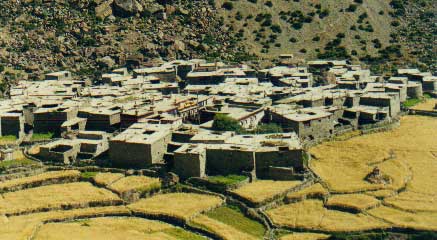
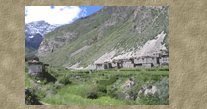
Weltse is the middle village of Limi. There are 70 households. The population of village is over 650, divided into three categories: “big households”, “small households” and “single woman households”. Wel" means side and "Tse" means top, in Tibetan. Weltse's name comes from its location by the side of Chu-Karmo (white river) and on top of the rocky hill called Bodreg Chung. Click here to learn the households system of Limi. | |
|
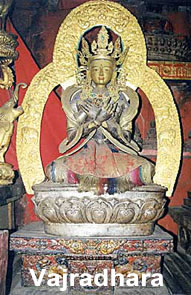 A
25-inch-high bronze image of Dorjee Chang (Vajradhara) is one of
the monastery's most important contents. "Dorjee" in Tibetan
translates as Vajra in Sanskrit, which symbolizes eternity and stability;
"Cheng" means hold in Tibetan; Vajradhara means the one
who holds eternal realization, that is Mahamudra, or enlightenment.
A
25-inch-high bronze image of Dorjee Chang (Vajradhara) is one of
the monastery's most important contents. "Dorjee" in Tibetan
translates as Vajra in Sanskrit, which symbolizes eternity and stability;
"Cheng" means hold in Tibetan; Vajradhara means the one
who holds eternal realization, that is Mahamudra, or enlightenment.










| All contents of this website © 2005 Kailashzone Charitable Foundation |
